
Burning Woman
She burns. She also burns.
Nightmares were common guests in Ashenhold. Almost everyone who had lived there long endured heavy, dark dreams that took more from them than sleep gave back. In autumn the dreams only deepened.
They had never come for Sorina. Not once in twenty-two years.
Whether that was a mercy or a quiet kind of exclusion, she had long since stopped wondering. This morning, however, something else troubled her, smaller than a nightmare and harder to name.
Three books sat atop the shelf, apart from their fellows, as though banished. She knew every volume in her aisle by heart; she had counted them, dusted them, returned them to their places more often than any reasonable person would. And she was certain that last evening these three had stood where they belonged.
Someone was here, she thought, and a tremble ran through her thin fingers. While I slept.
She rose from her low stool behind the shelves. Anyone passing would normally have seen only the top of her head, and a little of her brown hair; now she stood on tiptoe, scanning the hall from end to end, as though the intruder might still be loitering by the planters, or the shuttered storefronts opposite.
Empty, of course, in the early grey of a September morning.
She returned to her stool, pulled the books into her lap, and tried to settle her thoughts with something simpler. The week’s balance: she calculated it twice, twirling the pen in her fingers, and arrived both times at the same answer, nearly broke, as she had been all the previous year. That was an old problem, not so disquieting as the other.
If she let herself, she could imagine a hundred explanations for the books. A draught. A pigeon, somehow. Her own absent-minded hand the evening before. She could imagine them and not believe a single one.
The day brought a handful of tourists, weather-tired travellers grateful for any roof. They bought a few paperbacks. A local came in just after noon, picked up a volume of poems, turned it twice in her hands, and set it down with the small, troubled look of someone who could not quite recall what she had come for. She left without speaking. Sorina marked it down, vaguely, to the season.
By early evening she had given up on further custom and saw out the grey day behind her shelves. A book lay open on her knee, long unread.
The shop, what was left of it, had been her mother’s. There was a library before, in a different building and a more generous century; her grandmother had been its keeper, and her great-grandmother before that. When the library closed, her mother had crossed the street, rented a unit in the new mall, and called the work by another name.
Sorina had inherited the rest: the books, the compromise, the quiet daily belief that next year might yet be different. It was a thin belief. But thin or not, it had kept her here through a year of nearly-broke balances, and would, she suspected, keep her here through another.
She closed the ledger and, seeing no one else likely to want a book at this hour, called it a night.
She took up her worn vanity case and crossed the hall to the ladies’ room for her evening routine. When she came back, the overhead fluorescents were off, leaving only the faint standby stripes along the walls. She needed no more than the dimmest glimmer to find her way.
Sorina unrolled her sleeping bag in the gap between two shelves. She was petite enough to lie full length in the improvised alcove. Settling in, she thought of the three books, and of how close to her head they must have stood while she slept.
Sleep did not rush her. For a long while she lay gazing up at the distant glass roof and the steel beams that vanished into the dark, into the deep shadow gathered between them, where the standby stripes could not reach. No stars tonight, for the weather. She watched that shadow longer than there was reason to, but nothing in it moved.
At last she buried her face in the folds of the bag.
Only once, hours later, did a dark dream brush against her mind. Sorina shifted, searching blindly for the book she’d been reading; when her hand found its familiar cover, she calmed.
The scent of book dust was her comfort, and she needed no other.
* * *
The blare of the fire alarm ripped her from sleep.
Drowsy, she thought the sound had come from inside her own skull. She sat up and coughed, and the air she drew in was thick with the stench of melting plastic. Dark smoke drifted above her, crawling towards the parking ramp, and for a long moment she only lay there and watched it, and did not move.
No – not a dream.
The thought arrived too slowly to be any use. The smoke pressed lower, and she moved; the sleeping bag tangled her legs. She kicked free and dropped to her hands and knees.
Bending beneath the swirling clouds, Sorina set off along the aisle she could have walked blindfolded, and found her own shop turned hostile: a shelf where there should have been air, a turn where there should have been an aisle. Her hand brushed a book and she nearly took it, before she remembered that both her hands were on the floor, and that one book was no better than none.
Somewhere behind her, glass came down in a shattering cascade. She shuddered and pushed on towards the fire exit, gripping the wall.
The crash bar gave under her weight.
A thin rain met her outside.
Dawn was breaking in the distance above the low buildings of Ashenhold, its pale light barely piercing the brooding sky.
“Oh God!” she cried as the cold, damp air bit her skin. “I left everything there!”
She lurched to go back.
The door was already beyond reach: a black, foul-smelling smoke seeped from its frame. Sorina drew back, shivering in her thin t-shirt and jeans. Sirens wailed and the fire alarm blared, the two sounds fusing in her head. She stepped back another pace as the glass roof folded and collapsed inward, sending up a shower of sparks. A dark cloud rose over the mall and was lost to the air.
She did not move while the firefighters worked. At some point a blanket settled over her shoulders, though she did not see whose hand had placed it there. The ruin stood reflected in her eyes – blackened beams, broken glass, water running in streams down the car park – and behind them no coherent thought at all.
“Miss Richele,” a male voice called from behind her.
She did not answer.
“Miss Richele!”
Then she turned.
The police officer regarded her wearily. “Miss Richele. Do you have anywhere to stay?”
“That was my home,” she replied, waving a vague hand. “I need to get inside.”
“You can’t go in there. It’s all burned out.”
“There is a safe,” she countered. “With my documents and money. It’s fireproof… or at the very least, I was told so.”
He looked at her a moment longer than he needed to. “Do you know how it started?”
“No.”
He nodded once, slowly, and did not press her. “We’ll know more later.”
She stayed still while the morning came up grey and the fire went from blaze to smoke to a wet, black quiet. No one hurried her, and when they told her she could go in for the safe, she had lost track of how long she had stood.
Accompanied by a firefighter who walked a pace ahead in silence, Sorina picked her way between the debris. Looking up once, she saw a pale sky framed by the jagged, broken roof.
Little remained of her bookshop. The fire had taken its contents and the water had finished what the fire began.
She stood among the shelves, where the books lay swollen and black, fused to one another and to the wood, and she made herself look at them the way you look at a face you will not see again. Here and there a spine had kept enough of itself to be known, a title half-legible under the soot, a colour she had reshelved a thousand times. She crouched and reached for one, and her fingers came away wet and black, and the cover came with them, soft as ash.
Sorina did not reach for another.
Only then did she turn to the corner where the safe stood and kneel before it. At least that much had been true, she thought, turning the lock and peeking inside: the safe had resisted the elements.
With a meagre collection of her belongings in a bag slung over her shoulder, she stepped outside and sat on a bench, turning away from the mall. She couldn’t look at it any longer. Her hands were black to the wrist, and the smell of char had settled into them; behind her eyes the books were still burning, spine after swollen spine catching and curling to ash.
Then came a shiver that had nothing to do with the morning air. I could have been in there. As burned out as my books. The chill of it would not let go, though she wrapped her arms around herself and held on.
Breathe.
Breathe.
Little by little, it passed. “What now?” she muttered, watching the low, white clouds drift across the sky.
* * *
“I can provide an answer, if it be your desire.”
The voice came from beside her, neither welcoming nor forbidding, pitched not to startle her.
Sorina turned slowly and arched her brow despite herself.
The woman was plainly dressed in jeans and a blouse, yet she carried herself as though clad in a Victorian gown with a bustle. Her gaze did not rest on Sorina at first; it lingered past her shoulder, as if she half-expected another figure to step forward and join the conversation.
“Sorina Richele,” she said, returning her gaze to her at last. “The girl living in the mall.”
“Past tense,” Sorina said in a dry tone, steadier than she expected. “And you are?”
“Veyra Alpenholz.”
The name meant nothing to her. And yet you know mine, Sorina thought, watching her. “How is it that you know me, Miss Alpenholz?”
“Ashenhold is not a large town, Miss Richele. A young woman who keeps a bookshop alone is not difficult to hear of.”
It was one of those answers that didn’t answer anything. She filed it away, not with suspicion exactly, but with the small dry attention she gave to a book whose binding did not match its title page.
“I shall propose a position to you, Miss Richele.”
“A headless chicken may run around the yard for some time,” Sorina said. “But it is already dead.” She meant herself, and did not explain.
Veyra let out a short, uncomprehending laugh, as though the expression had reached her from a great distance and arrived without its meaning intact. “I heard you have a remarkable affection for books.”
Sorina sat up a little straighter. The wrung-out morning shifted around the shape of those words. “I am intrigued,” she said, and her voice wavered only a little. “Tell me more.”
“Please, Miss Richele.” Veyra extended a hand toward the car parked at the curb, a green Buick that looked stranded from the sixties. “I want to show you something first.”
Some sensible part of her knew what this was – a stranger’s car, an hour after losing everything – and that part had gone quiet in the smoke. The woman did not look like danger; she looked like she had already decided, and was waiting without impatience for Sorina to catch up.
And she had said books.
Oddities, Sorina thought, settling into the passenger seat. But I have nothing to lose. She remembered what little money she had in her purse. She had meant it more literally than she would have liked.
Veyra took her place behind the wheel, checked the mirrors, and cast a short, cool glance at Sorina, silently reminding her to fasten her seatbelt. Only then did she start the engine.
“So what’s the job?” Sorina asked, watching her sideways as the car left the carpark.
“We shall speak of it when we arrive, Miss Richele. I do not have the habit of talking and driving at the same time.”
Sorina looked out, casting a last look at the mall before it disappeared behind them. The black smoke had thinned into something the wind was nearly finished with.
The streets of Ashenhold stretched out, with the low stone houses huddled together, their shadows long in the autumn light. Sorina noticed, idly, that Veyra had no phone mounted on the dashboard, no holder, no cable. The car contained nothing that had been manufactured in the last forty years except, perhaps, Veyra herself. She also noticed the wristwatch on Veyra’s left hand, an old wind-up thing, and the way Veyra glanced at it once at a junction, as though checking a thing she trusted.
They left the town soon enough, heading toward the hills that cradled it on the northern side.
Squinting at the sun, Sorina spotted a dark house perched atop one of the hills, surrounded by a rusted cast-iron fence. She knew the house, of course. Everyone did. Some said a witch had once lived there; some said one still did.
They were heading exactly where she suspected.
To her mild relief, the house turned out to be not as gloomy as it seemed from a distance. A two-storey, L-shaped building with a paved courtyard in its inner corner. The walls were dark wood, but the interior, when they stepped into the hallway, was pleasant in a slightly old-fashioned way: beeswax and dry timber, a runner that had been beaten and replaced and beaten again over a long life.
Sorina paused before a mirror framed in ornate metal.
“I live alone,” Veyra said, as though it answered something. “You should wash your face, Miss Richele. The bathroom lies adjacent to the kitchen. The bedrooms are in the wing; yours is behind the last door.”
Sorina snorted softly, turning to her. Since when does a stranger give shelter to another stranger like that?
“Is something amiss?” Veyra asked, glancing over her shoulder.
“I suppose it will be an unusual prospect to sleep in a bed after a year spent on the floor. But I must admit, I’m a little confused, for I’ve still heard nothing of what I’m meant to do.” She heard the shape of it a beat after it left her: unusual prospect, I must admit, for I’ve – and stopped. When had she started talking like that?
“It will be quite an endeavour to explain it in a few words.” Veyra paused at the foot of the stairs. “Let us each take a moment, and meet again on the upper floor. I am sure you shall find it… illuminating.” She gave her a smile that Sorina read as reassuring.
“Very well, Miss Alpenholz. Though I remind you that I still have no idea what you want from me, nor what the job is.”
Veyra inclined her head. “I shall be upstairs.”
Sorina watched her go. Then she went to read the house.
* * *
She found the bathroom near the kitchen and stepped inside.
It was the nicest bathroom she had ever stood in: leaf-green tiles, copper faucets that had been polished by hand not so long ago. The soap by the basin was a pale, heavy bar of something she did not recognise, faintly herbal, expensive in a way Sorina could not have priced. There was one towel on the rack, a single comb on the shelf. A half-used jar of something, bath salts, perhaps, with the lid set carefully back.
A woman who lives alone, Sorina thought, and likes the small good things. And has not shared this room with anyone in a long while.
Her own face in the mirror was a poor contrast to the rest of it: sooted, hollow at the eyes, hair in disarray. She washed slowly, watching the water run grey, then less grey, then nearly clear. The smell of the soap clung to her hands afterwards.
She found the left wing without trouble and walked its hallway. There were pictures on the walls: small framed prints, a watercolour of a coast, and, near the last door, a photograph. Two women in plain clothes, standing close but not touching, neither posed nor caught off guard. It took her a moment to place the older of the two: Veyra, younger by a few years, the same straight bearing, the same unhurried eyes. The other stood a half-step closer than Veyra did, and did not seem to mind.
The glass had been wiped clean not long ago; she could see where a thumb had cleared the dust at one corner. Lives alone, Sorina thought, and looked again at the two of them standing so close. Now, perhaps. She went on.
The bedroom was small but cosy, light-peach walls, a dark oak wardrobe, a curtained window at the bed’s headrest. Mine, she thought, stepping in, though the word didn’t fit yet.
She knew at once that the room had been waiting: the bedclothes had been aired, the wardrobe stood empty but not dusty. A glass on the nightstand had been washed and set out for someone who had not yet arrived.
For someone who slept in a sleeping bag between bookshelves, you are being far too fussy, she chided herself, and yet stood a moment longer, taking the room in.
Sorina set the surviving García Márquez on the shelf above the bed and ran a thumb along its edge – the same book she had reached for in the dark, half-asleep, more nights than she could count. The sleeping bag had taken the worst of the fire and the water both, and the book had come through with only a scorched corner and a faint smell of smoke. Of all the things to survive, she was glad it was this one.
Then she straightened, drew a long breath, and went out to the stairs, where she stopped. Whatever the job was, whatever Veyra meant to show her, it was up there, but it had been a long morning, and she was not sure how much more of it she could take in before lunch.
She put a hand on the banister and went up anyway.
The entire upper floor, open from window to window, was a library.
Shelves rose to the ceiling, stretched away from her in lines that bent around alcoves and benches and the occasional reading table, and vanished around two further corners she had not yet seen. The light from the tall windows fell in pale columns across the polished floor, and the motes turned in them without hurry. Sorina took in a full lung of the familiar aroma of book dust, and a pleasure settled in her chest.
“Please, Miss Richele.” Veyra’s voice came from somewhere among the shelves. “Don’t be shy.”
“Don’t tell me you need a librarian,” Sorina said, finding her in an alcove between two cases. The line came out lighter than she meant; under it sat a small, embarrassing wish that it might be true.
“Of course not,” Veyra replied. “It is rather more complicated. I shall begin at the beginning.” She gestured for Sorina to sit opposite her on a bench, and settled herself more comfortably. “Books are dangerous.”
“So is a kitchen knife in the wrong hands,” Sorina said, and winced. She had no patience for that kind of philosophic ramblings, and had just produced some.
“I mean literally, Miss Richele.” Veyra’s tone hardened. “Books that bind their readers to the will of the page. That warp dreams into torment. Books whose mere presence can unmake sanity.” She rose, crossed to a glass display case set against the nearest wall, and unlocked it.
The book inside was worn, its title unreadable on a dark blue cover.
Veyra drew on a pair of gloves. She lifted the volume with both hands, slowly, and kept it away from her body. “This is one of the last copies of Fur Animarum. Third-degree danger.”
“I beg your pardon?”
“Take it, Miss Richele.”
Sorina stood and took the book in her hands, and the floor went briefly sideways. She meant to sit back down and found that her arms and legs would not answer her. The texture of the cover was no longer under her fingers – only the weight of the book, and the weight had a downward intention of its own.
She raised her head with effort and moved her lips, to no sound.
“I think that is enough,” Veyra said, perfectly calm, and stepped forward. “Allow me.” She took the book from Sorina’s hands, returned it to the case, and turned the lock. The click resonated in the library’s silence.
Sorina collapsed onto the floor.
“What was that?” she managed, sensation returning in slow, prickling waves.
“Fur Animarum. Third-degree danger. Gloves are mandatory.” Veyra knelt beside her. “There are far worse books. Ones that cannot be contained so easily – or ever.” Her voice went flat.
“What do you do with them?”
“I burn them.”
* * *
The sun flooded the library, but Sorina knew these were the last of the bright days before October would blanket the town in rain. She set the book aside, turned to the window, and let the light fall on her face.
Five weeks now. Long enough that the silence between footsteps in this house had become a sound she recognised. Long enough that the smell of book dust at the top of the stairs was the smell of where she lived.
Then she heard steps on the stairs.
“Let us continue,” Veyra said, pacing back and forth between the shelves. She always resumed without preamble, as though the lecture had never been interrupted. “Remind me of the classification of danger levels.”
Sorina furrowed her brow a moment. “Third level: manageable danger at direct contact. Second level…”
Fur Animarum subdued me that first day because I was not ready, she thought. She had taken it bare-handed since, more than once, and found it grew lighter each time – or her hand steadier.
“…first level: an unambiguous threat to life from afar. An exceptional danger. Impossible to contain safely.”
“Verdict?”
Sorina hesitated. “Burning on site.”
“I had an apprentice before you,” Veyra said, in the same cold, measured tone she used for lectures. “She died.” She raised a hand before Sorina could speak. “I have no use for your compassion, Miss Richele.”
Sorina noticed Veyra’s fingers shaking, and the gaze that would not settle, drifting from shelf to shelf.
“Compassion aside,” Sorina said, sharper than she meant, “I am not going to repeat her fate. What happened?”
“She was careless and unprepared.” Veyra paused. Her voice tightened to nothing. Then she straightened. “Miss Richele. Find me in the study presently. We shall continue there.”
“Of course, Miss Alpenholz.”
Ten minutes later, Sorina went downstairs.
“I suppose you are ready to learn, at last, why I am here,” Veyra said, not looking up from the papers she was sorting.
“Bet you’re living here,” Sorina tried, settling into a chair.
“How amusing,” Veyra said, without amusement. “I travel extensively in search of books. And yet, Miss Richele, I wonder – have you ever pondered why the folk of Ashenhold are haunted by nightmares?”
“I don’t have them.”
“That is another reason I chose you. I have observed you. You have a remarkable resistance, a trait we share, I daresay.”
Sorina sat very still a moment.
“Observed me,” she repeated.
Veyra looked up at last.
“You watched me.” Sorina’s voice climbed. “You came into my shop. You moved books on my shelves while I slept. You watched me sleep, didn’t you. And then – then the fire. How convenient for you, that I lost everything on the same morning you needed an apprentice. Did you–”
She did not finish. She had not meant to go as far as the fire.
Veyra did not interrupt. She let the silence stretch until Sorina heard it, then laid her papers down like a knife beside a plate. “I did not set the fire, Miss Richele.”
It came out quietly.
“I did not touch your books.” For an instant something passed behind Veyra’s eyes that was closer to puzzlement than to offence. “I do not know who did.”
“And the watching?”
“That I will not deny.” Veyra’s hands had returned to perfect stillness. “I observed you, yes. In the shop, and once or twice in your sleep. It is the way to know whether one is perceptible to nightmares.”
She believed her, and was annoyed to find that she did. A woman who would admit to standing over her while she slept had no reason to lie about a fire. Sorina opened her mouth and closed it.
The hallway came back to her without warning, that photograph near the last door, that other woman in the picture who had not been a stranger to Veyra. She had watched her sleep too, once, in this same way, and judged her resistance, and brought her here.
Sorina’s anger held its shape and lost its centre. She was in a room with a woman who had done a difficult and slightly terrible thing more than once, and who had not flinched from doing it again.
“You could have told me,” she said.
“I am telling you now.”
Sorina slowly exhaled and looked at the papers on the desk to give her eyes something to do. “My apologies. For the fire. I should not have said it.”
“Accepted.” Veyra’s expression eased by some small fraction. “The reason for the nightmares: a long-forgotten archive of forbidden texts lies beneath the mall.” She drew a folded diagram from the papers and laid it on the table between them. “I suspect there is a first-degree danger book there.”
“What kind of book?”
“I have no idea.” Veyra looked at her directly. “We must investigate with every precaution, ready to burn it on site. Today. Now – go and prepare yourself.”
I do not know if I could bring myself to burn one, Sorina thought.
She did not say it aloud. She did not want Veyra to think badly of her.
In her bedroom, she dressed for the outside. There was little they could do to guard against dangerous books beyond closed clothing, masks, gloves, and goggles – barriers against touch, and touch was the least of what a first-degree book could do.
Sorina checked the gas torch, filled the vials with burning fluid, and turned once before the mirror.
“My god,” she muttered. “I look as though I am preparing for a siege.” She heard it, and did not correct herself.
She was not sure any of it would help if they met a first-degree book. If Veyra was half as serious as she claimed, and her tales even half-true, they were already lost long before they could do anything.
* * *
Sorina did not know how she felt about not going to the mall. Part of her had wanted to see the old place; part of her was glad of the spared wound. In the end she decided it was for the best.
Veyra stopped the car by a derelict house at the end of Lumberjack Street, a few blocks from the mall. The houses on either side leaned slightly toward one another, the street empty in the afternoon light. A cat peeked its black-and-white head out from under the fence and was gone again.
“I shall remind you of the safety rules, Sorina.” Veyra did not look at her. “You do not touch anything, not even with gloves. You do not put your hands where you cannot see. You watch your feet. You watch around you. You watch above. You stay vigilant.”
“Yes, Miss Alpenholz.”
“Veyra. Down there we shall not have time for politeness.” She smiled, and the smile changed her for a moment into someone almost easy to know. “Go on, now.”
They got out of the car and through the creaking gate into a yard overgrown with grass and bushes. Veyra looked around a moment, then strode toward what looked like a low hill against the house’s wall and turned out to be a cellar entrance.
“I wonder how you found out about this,” Sorina said, descending the stone steps after her.
“Our archives are extensive, and I assure you there is much to find in them.” Veyra switched on her flashlight and swept it around. “This passage dates from the eighteenth century. It was a casemate once, and later taken over by followers of a little-known sect.”
“Good heavens.”
“You would not believe the places one is sometimes obliged to enter.”
For a time they dug at the far wall of the cellar, taking turns. The air was damp, thick with mildew and a sour edge beneath it that Sorina could not place. At last they found what they had come for: a long-buried hatch.
“Allow me,” Veyra said, unclipping the crowbar from her backpack. She rammed the narrow end between the hatch and the frame and prised it slowly open. “The best key to any door,” she said, and there was something almost like a chuckle in it.
Sorina very nearly laughed.
But as soon as they had crawled through the hatch and dropped into the stone corridor, Veyra’s expression turned serious in the flickering light. “Something’s here,” she said, and went still, her head tilted, reading the air the way she read a shelf.
The air changed. The mildew thinned, but the sour edge beneath it did not; it sharpened, climbing, a smell like fruit gone over and something underneath the fruit, until it sat at the back of Sorina’s throat and stayed there. She would have known it again anywhere. She blamed it on the cellar and walked on.
The corridor ran on into the dark: grim walls, an arched ceiling, the far end lost to the flashlight’s reach. A chill went down her spine, and for once she did not stop to examine it.
“What’s that smell?”
“Hm?” Veyra glanced back. “Mould?”
Sorina shrugged. It seemed, at the moment, plausible enough.
The corridor ended abruptly, opening into a circular room with a beamed ceiling. Stone shelves lined the walls, stacked haphazardly with books, their spines unreadable.
“Unbelievable,” Veyra murmured, horror and awe at once in it. She set the flashlight on the ground, the beam throwing long, trembling shadows up the walls, and began to circle the room with measured steps. “Fascinating… truly fascinating.”
…Sorina…
Her name. Not a voice in the room, but a voice under it, the way a hand is under a glove. She shivered, and made herself stop. She was used to the quiet commentary that ran in her, the cost of living too long alone with books; an unfamiliar voice was still only a voice. She turned back to the room, slower than she might have on another day, and watched Veyra circle.
Veyra straightened, came back to the flashlight, lifted it. She turned the beam full on Sorina’s face, and Sorina flinched, shielding her eyes.
“Hey!”
“I am sorry you had to see this.” No regret in it. “I liked you.”
A blade caught the light in her hand.
…Sorina…
Sorina stumbled back, her spine hitting the shelves, two books knocking to the floor. “Hold on–”
This is all wrong, she thought. This – oh. I see it–
The blade went in below the collarbone, a cold line and then a spreading heat, and cut the thought in half.
* * *
As soon as they had crawled through the hatch and dropped into the stone corridor, Veyra’s expression turned serious. “Something’s here.”
Sorina shook her head, trying to clear it.
She had the sudden, bone-deep sense of having stood in this exact spot before. The pain came a half-second later, held beneath her left collarbone: a cold line, and then a spreading heat, as though her body had decided to remember something her mind had not yet been told.
…kill or be killed…
She turned her gaze downward and found a knife in her hand, fitted to her palm so comfortably that she did not at first notice it. Her eyes shifted to Veyra, who stood with her back to her, reading the air.
So simple. And the book would be hers.
…what book?…
She flung the knife away, startled by the thought, and it dissolved from her fingers like a thing that had never been there at all. “Veyra!”
Vox Ultima.
The name materialised in her mind of its own accord, and with it the book, chained in a niche, waiting for a new owner.
Veyra turned to her, and where her face should have been there was a skull – a dead grin, a hollow stare.
“No.” She did not know whether she had spoken it or only thought it. It was harder than with Fur Animarum, far harder, impossible to break free of. She felt herself crumbling beneath the weight of it.
The corridor dissolved. The walls collapsed outward and were gone, opening onto a new scene.
A cemetery under a grey, rainy sky.
“There is a time for everything,” the pastor intoned, reading from Ecclesiastes, his hands folded and his gaze fixed on nothing as raindrops ran down his cassock.
Sorina looked around her.
“That very day,” a low male voice remarked from her right. The wide brim of the speaker’s hat hid his face. “The day everything fell apart.”
“The day my mother was buried,” she said. “What is the point of all this?”
“I thought, perhaps, you might wish to remember where everything began. And change something.”
“The dead are dead.”
“Questionable.”
Vox Ultima.
She turned her head to look at him directly, to read his expression, to see whether the irony reached his eyes. The brim of his hat cast a shadow where his face should have been, and for a moment the shadow was all there was: no face beneath it, no features surfacing from the dark. Then the man was there again, attentive, half-smiling, as though nothing had happened.
He nodded as if she had spoken. “Pleased to meet you, Sorina. I have been watching you all this time. Reading your books while you slept.”
“You couldn’t have.” She caught at last the thought that had been gnawing at her since the scene began. “I never had nightmares. Not one.”
She was back in the corridor. It took her a few seconds to realise that Veyra lay on the floor, unmoving.
Sorina rushed to her, struggled to turn her over, pressed her fingers to her neck and found a calm, steady pulse. No matter how she tried, she could not rouse her. At last she eased her into a more comfortable position, took up the flashlight, and walked down the corridor toward the circular room.
All this could be another set piece, she thought. I am not even sure where I am.
A rustling laugh echoed from nowhere.
“You are wrong to laugh,” Sorina hissed, fumbling for the gas torch at her belt. “Let me show you.”
…fire does not scare me…
She brushed the whisper away and quickened her pace, feeling herself losing touch with the ground beneath her. The corridor pitched, like a rope bridge over a chasm.
She put a hand on the wall. The stone was cold and did not move. She counted twelve steps along it, and then twelve more.
“It is hard for me to believe you did not want to fix everything. Escape poverty. Live a life you deserve.”
Sorina was at the cemetery again, watching the coffin lowered into the ground. This time she did not even respond. She crushed the illusion like a ruined sheet of paper.
You cannot buy me that way.
“Fair,” the book replied. “How about this?”
She flew out of the corridor and into a vast, hexagonal room with a dark opening in the middle, walls lined with towering bookshelves. “Borges’ Library. Very nice.”
“Charming, is it not?” the voice sneered.
“Very nice,” Sorina repeated, and threw herself over the balustrade into the dark, only to find herself in the corridor again.
“You know what Veyra hides?” The book’s voice tightened, hunting now for purchase. “Want to see why she is so desperate to burn books? She lost her last apprentice. She is guilty of it. She is a bad teacher.”
The photograph rose unbidden in Sorina’s mind – the other woman standing that half-step closer, the thumbprint cleared in the dust at one corner of the glass. The grief Veyra would not name. The room kept ready, in case.
It was not the corridor that swayed beneath her, this time. It was something inside.
“Oh yeah?” she said, forcing the words past it. “Taught me well, I daresay.”
“How would you know? You have never met anyone like me. Fur Animarum is a joke. A child’s toy. I could crush your bones, you know.”
“I am going to see you burn,” she said, and tried not to let it hear how tired she was. Each illusion now was another brick laid on her back.
The corridor twisted into an interior she had not yet seen. It might be real this time, she thought, her whole body aching, every joint protesting the next step.
There was no room, no corridor, but only a raw stone wall with a deep niche carved into it, the very niche she had glimpsed before, and inside it the silhouette of a dark tome, its chains stirring.
She had come a long way to stand in front of it, and it had been waiting the whole time.
“You are a good student.” Veyra’s voice, behind her, warm in a way it had never quite been. “When did you realise this was the one that had us?”
“When you stabbed me,” Sorina said, not turning.
“Ah.” A short laugh. “It likes to see people kill one another. You have earned it, Sorina. Take it up. Carry it out into the light, where it belongs. That is your trophy – after everything, you have more right to it than anyone living.”
Sorina turned.
For the length of a breath Veyra was not there, only the dark of the corridor behind, and the body on the floor where she had left it, breathing, not moved; and then she was back, close and kind, waiting.
Take it up. Her arms were lead; her thoughts came slow and warm, like the beginning of sleep. She understood that she was being told to finish this. Yes. Finish it.
She turned back to the niche. In the beam of the flashlight she could see it properly at last: the dark nap of the velvet, the corners worn soft, the chains lying slack across it as though they had never been needed. Don’t judge a book by its cover. The gods themselves were her witness that she wanted to.
Sorina drew the torch from her belt and clicked the switch, and a narrow tongue of flame stood up from it.
…burn me, will you? Can you?…
Her hand trembled.
* * *
The winter sun flooded the library.
Beyond the tall windows the snow fell slowly, painting the hills white, and inside it was warm and pleasant to sit with a book in her lap. Sorina set it aside – an old volume in translation, one Veyra had laid out for her some days before – and turned to the window, letting the light fall on her face, something in her easing.
Then she stood and walked past the closed cabinets with light steps.
“Sorina.” Veyra’s voice came up from the stairs below. “The dead can wait, but the tea cannot.”
“A moment,” she answered, dry as the summons, and turned toward the row.
The arch of dark wood waited at the end of it, as it had waited every day since the first frost. Sorina stepped inside without hesitation, though the hesitation had been worn out of her, not absent from the start. She knew these books only from the archives and from Veyra’s careful accounts; she had not met them in the wild, as she had met the one in the niche. But she knew what each would do, and what she would do in return, and that, for now, was enough.
A white tome with blood-red letters shifting and warping across its cover lunged at her, snapping, hungry, and fell short, lifeless, chained to the wall.
Sorina did not flinch. “No, you don’t.”
She walked on past the others, the chained ones, each in its own quiet menace, and stopped before the display case at the far wall. It was locked, like the others. Even the dead are filed, she thought, with the faintest dry note that, a year ago, she would not have recognised in herself.
Inside, four letters remained on the charred piece of dark wrinkled velvet:
U… L… T… I
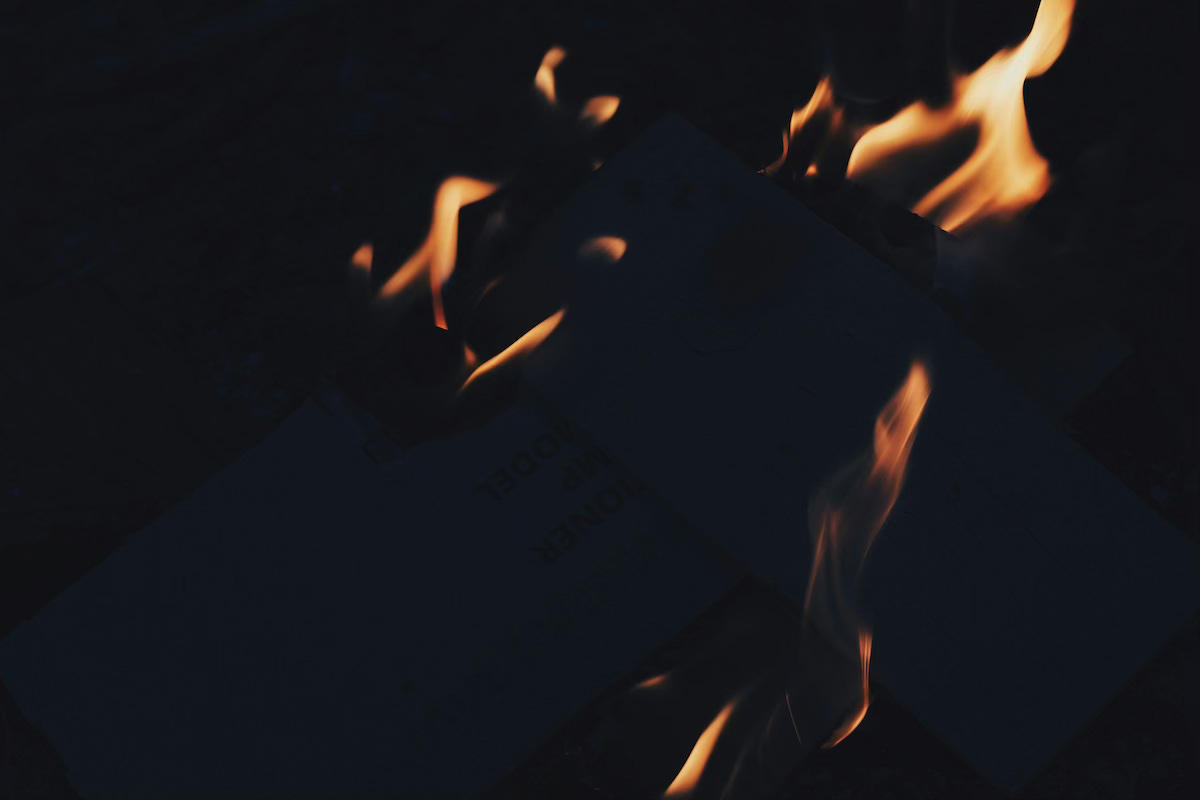
Photo by Ava Tyler on Unsplash
Burning Woman originally placed in a closed contest at a writing group. A few days earlier I walked through an underground passage, by a book aisle covered for the night with a black cover; coming closer, I heard voices from underneath. I imagined: what if someone lived in there?
The publication opens here. Next: a flash piece on 15th; I wish I could tell which one.
Thank you for reading.
Aldwin